History & Tradition
Neri-koh (練香, literally "kneaded incense") originated over a thousand years ago during the Chinese Tang Dynasty and the corresponding Heian period in Japan (794–1185 CE). While China's incense culture eventually declined, Japan preserved and refined the art of kneaded incense, continuing its production to the present day.
During the Heian period, incense was deeply woven into aristocratic life. Nobles created personal signature blends, and incense-blending competitions (takimono-awase) were popular court entertainments. The classic text Genji Monogatari (The Tale of Genji) describes characters identified by their distinctive incense blends as much as by their appearance.
Six classical neri-koh formulas became canonical, each associated with a season or mood: Plum Blossom (spring), Lotus Leaf (summer), Autumn Leaf (fall), Chrysanthemum (late autumn), Fallen Leaves (early winter), and Black (deep winter). These recipes have been passed down through incense families for centuries, each house maintaining its own secret variations.
How Neri-Koh Works
Unlike combustible incense, neri-koh is never burned directly. Instead, small balls of the kneaded mixture are placed near, not on, a heat source, typically a buried charcoal ember. The gentle warmth releases the fragrance slowly and cleanly, without combustion smoke. This produces the purest possible expression of the aromatic ingredients.
The binding agent (honey or dried plum flesh) serves a dual purpose: it holds the powdered ingredients together and undergoes a slow chemical transformation during aging that deepens and integrates the scent. A freshly made neri-koh ball smells like its individual ingredients; one aged for months smells like a unified, complex fragrance that's more than the sum of its parts.
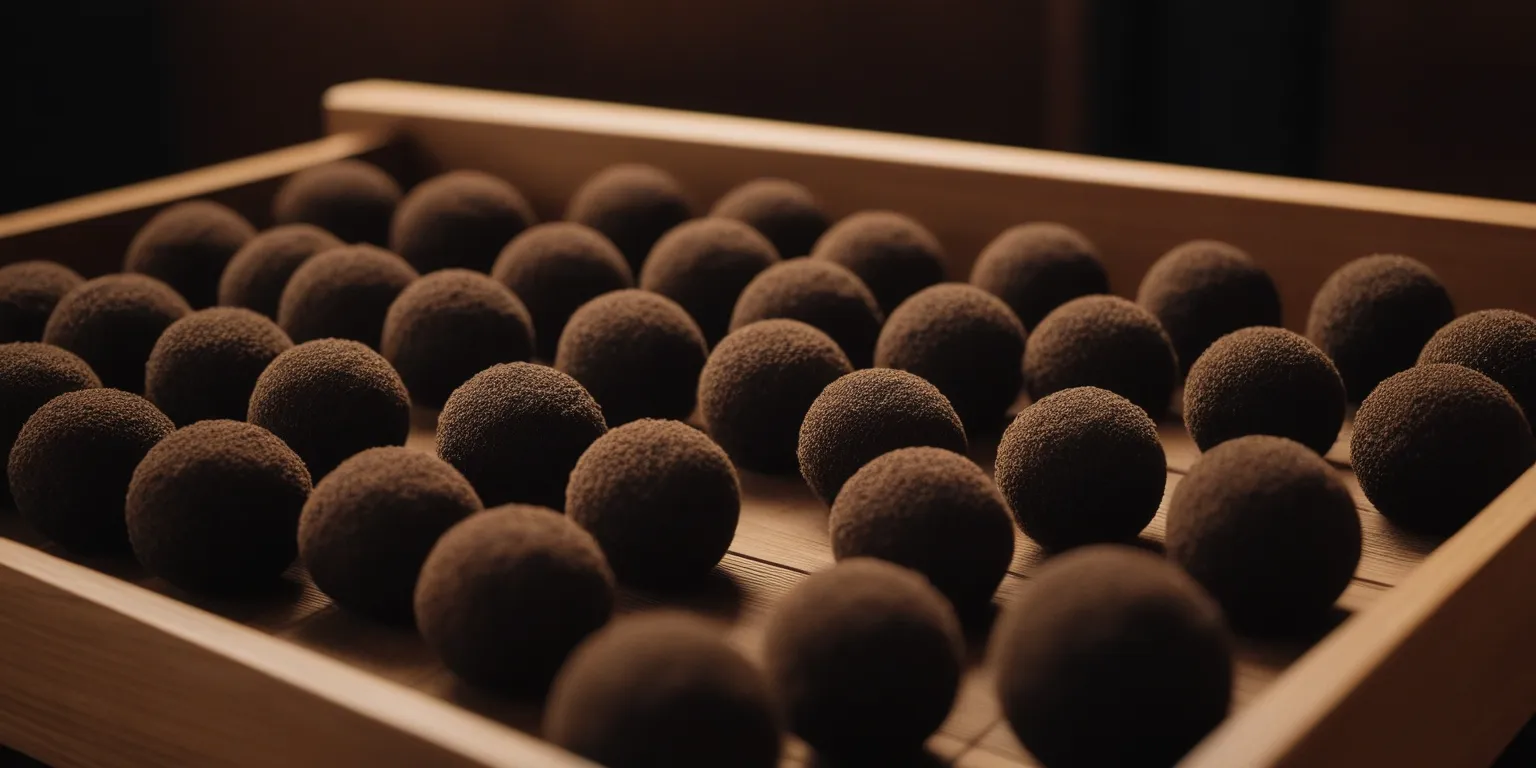
A Living Fragrance
Freshly rolled neri-koh balls are dark, glossy, and pliable. Over the coming months they undergo a slow transformation as the honey binds with the aromatic powders, producing scent compounds that didn't exist in the fresh mixture.
Ingredients
Aromatic Powders
Traditional neri-koh recipes use combinations of the following, all ground to fine powder:
- Sandalwood - the foundational wood in most recipes
- Agarwood (oud) - the prized top-tier ingredient, used in small quantities ("knife-tip" amounts)
- Clove - warmth and spice
- Cinnamon bark - sweet warmth
- Frankincense - brightness and lift
- Benzoin (Siam) - sweet, balsamic depth
- Camphor - a sharp, cooling accent (natural only)
- Borneol - similar to camphor but subtler
- Musk - traditionally animal-derived, now usually plant substitutes like ambrette seed
- Spikenard - deep, earthy, musky
Genuine agarwood is extremely expensive and many of the ancient recipes that call for large quantities are prohibitively costly today. Modern practitioners typically use small amounts for accent, or substitute with agarwood-infused sandalwood. Even a tiny amount of real oud transforms a blend, so don't feel you need large quantities.
Binding Agents
Two traditional options:
- Honey - the most common binder. Wild honey is preferred for its naturally lower water content. Regular honey must be cooked first (see below).
- Dried plum flesh - the traditional Japanese alternative. Provides a slightly tart binding character.
- Combination - some recipes use both, sometimes with a splash of plum vinegar.
Optional Additions
- Charcoal powder - a small amount prevents mold growth and absorbs excess moisture
- Plum vinegar - mixed with honey for an intensified tartness
Preparing the Honey
This step is critical and often overlooked by beginners. Raw honey contains too much water for neri-koh. Excess moisture causes mold, weakens the balls, and introduces a burnt-sugar note when heated.
The solution is to cook the honey, a process called lian mi (炼蜜) in Chinese tradition:
- Place honey in a heavy-bottomed saucepan over the lowest possible heat
- Stir continuously for approximately 20 minutes
- The honey will thin out as it warms, then gradually thicken as water evaporates
- Skim off any foam that rises to the surface
- The honey is ready when it has darkened slightly, thickened noticeably, and a drop placed on a cold surface holds its shape without spreading
- Allow to cool before using
Hot honey is extremely sticky and retains heat. Work carefully. Do not let it boil vigorously; maintain a gentle simmer. Overcooked honey turns bitter and will ruin your blend.
If you can source wild honey (which has naturally lower water content from extended storage in the hive), you may be able to use it without cooking. Test by pressing a drop between your fingers. If it's thick and tacky rather than runny, it should work as-is.
The Plum Flesh Alternative
Dried plum flesh (umeboshi-style dried plums, or Chinese preserved plums) is the traditional Japanese alternative to honey. It produces a slightly different character: less sweet, with a faint tartness that some practitioners prefer.
How to Use
- Remove pits from dried plums
- Pound the flesh in a mortar until it forms a smooth, uniform paste
- Gradually incorporate the aromatic powders into the plum paste, continuing to pound
- The mixture is ready when it no longer sticks to the mortar or pestle
Some recipes combine honey and plum flesh for a binding agent that has the sweetness of honey and the preservative tartness of plum. A small amount of plum vinegar can also be mixed into honey to achieve a similar effect.
Step-by-Step Process
Prepare All Powders
Grind each aromatic ingredient to a fine powder individually. Then combine all powders in a mixing bowl or large mortar and stir repeatedly until the mixture is completely uniform in color and texture. Every speck should be indistinguishable.
Add Honey Gradually
Add your prepared (cooked) honey to the powder blend a small amount at a time, stirring and folding after each addition. The critical rule: the honey should never be excessive. You're looking for a mixture that appears dark and wet but still feels slightly loose and crumbly, not a smooth paste, not yet.
It's far easier to add more honey than to fix an overly wet mixture. Go slowly.
Pound the Mixture
This is the most important step. Transfer the mixture to a mortar and pound with the pestle for 15–20 minutes. This isn't gentle stirring; it's vigorous, rhythmic pounding that forces the honey deep into every grain of powder and distributes all ingredients evenly.
As you pound, the mixture will transform from a loose, crumbly mass into a cohesive, smooth, dark paste. The mixture is ready when it begins to pull away from the sides of the mortar and you can lift it as a single mass. It should be glossy and pliable, like stiff modeling clay.
Listen to the sound of your pounding. Initially it will sound dry and granular. As the honey integrates, the sound becomes muffled and wet. When the mixture makes a soft, slapping "thwack" against the mortar with each stroke, and leaves the mortar sides clean, you're done.
Shape into Balls
Cut or pinch the dough into small, uniformly-sized pieces. Press and roll each piece into a smooth ball between your fingers. The traditional size is roughly that of a pea or small marble.
Important technique: Roll and press the dough; don't fold it. Folding creates layers that can split apart when the ball is heated. You want a solid, seamless sphere with the ingredients distributed evenly throughout.
Store for Maturation
Place the finished balls in an airtight container (ceramic or glass). Store in a cool, dark place: a cellar, a drawer, or a closed cupboard. The balls will begin their maturation process immediately, but the transformation takes time.
The minimum recommended aging is one month, but three to six months produces significantly better results. Some traditional recipes call for aging of a year or more. During this time, the individual scent components amalgamate into a coherent, unified fragrance that's richer and more complex than the fresh mixture.
Judging Quality
A well-made neri-koh ball exhibits these characteristics:
- Uniform color - no streaks or visible pockets of individual ingredients
- Round and seamless - smooth surface without cracks, folds, or seams
- Slight moisture - the ball should feel slightly moist and pliable, never dry or crumbly
- Honey visible - a properly bound ball may show a subtle sheen of honey at the surface
- Holds shape - firm enough to maintain its round form, soft enough to yield slightly when pressed
- Consistent throughout - if you cut one in half, the interior should look the same as the surface
Common Issues
Balls Are Dry and Crumbly
Not enough honey, or the honey wasn't well-integrated. You can rescue them by kneading in a small amount of additional cooked honey and re-forming. Pound longer next time.
Balls Are Too Soft / Won't Hold Shape
Too much honey. Knead in additional aromatic powder until the consistency firms up. Let the mixture rest and dry slightly before re-forming.
Mold Appears During Storage
Excess moisture. Add a pinch of charcoal powder to the mixture and re-form. Ensure your storage container is clean and the storage location isn't humid. Cooked honey is less prone to this than raw.
Balls Split or Crack When Heated
Usually caused by folding during shaping, or by air pockets in the dough. Roll and press firmly to eliminate trapped air. Never fold the dough over itself.
Aging & Storage
Aging is not optional for neri-koh; it's an essential part of the process. The fresh mixture smells like a collection of distinct ingredients. After aging, it smells like a single, unified fragrance.
What Happens During Aging
Several processes occur simultaneously:
- Volatile top notes slowly evaporate, leaving the deeper, more complex base and middle notes
- The honey undergoes slow enzymatic changes that deepen its character
- Aromatic compounds from different ingredients diffuse into each other, creating new scent molecules that didn't exist in the fresh mixture
- The overall scent becomes smoother, rounder, and more integrated
Aging Timeline
- 1 week: Slight improvement. Individual notes begin to soften.
- 1 month: Noticeable change. The blend starts to feel coherent.
- 3–6 months: Significant transformation. This is the sweet spot for most recipes.
- 1 year+: Deep, complex, highly refined. Traditional recipes were often aged this long or longer.
Store in airtight ceramic or glass containers in darkness. Check periodically for mold (especially in the first month). If the balls seem to be drying out, they may need a very light misting of cooked honey on the surface.
Heating & Enjoying
Neri-koh is heated, never burned. The goal is to warm the ball gently so it releases its fragrance as aromatic vapor rather than smoke.
Traditional Method (Charcoal)
- Fill a heat-proof vessel with fine ash (traditionally a ceramic incense cup called a koro)
- Light a small piece of charcoal and bury it in the center of the ash, leaving only the top slightly exposed or fully covered with a thin layer of ash
- Place a small square of mica plate (available from incense suppliers) on top of the ash above the charcoal
- Place the neri-koh ball on the mica plate
- The heat rises through the ash and mica, gently warming the ball without burning it
The ball should soften and glisten slightly as it warms. If it begins to smoke or char, it's too close to the heat. Add more ash between the charcoal and the surface.
Modern Method (Electric Heater)
An electric incense heater provides consistent, controllable heat and is the most reliable method for neri-koh. Set the temperature to medium-low and place the ball directly on the heating surface. Adjust temperature up if fragrance is faint, down if the ball begins to darken or smoke.
A single neri-koh ball can provide fragrance for 30 minutes to several hours, depending on size and heat level.
Classic Recipes
These recipes are inspired by traditional Japanese and Chinese formulations. Quantities are in relative "parts."
Autumn Leaves (Rakuyō)
| Ingredient | Parts |
|---|---|
| Sandalwood powder | 4 |
| Clove powder | 2 |
| Frankincense powder | 2 |
| Cinnamon bark powder | 1 |
| Benzoin (Siam) powder | 1 |
| Agarwood powder | knife-tip amount |
| Cooked honey | as needed |
Plum Blossom (Baika)
| Ingredient | Parts |
|---|---|
| Sandalwood powder | 3 |
| Frankincense powder | 2 |
| Benzoin powder | 1 |
| Camphor (natural) | ¼ |
| Clove powder | ½ |
| Dried plum flesh | as needed for binding |
Black Fragrance (Kurobō)
| Ingredient | Parts |
|---|---|
| Agarwood powder | 3 |
| Sandalwood powder | 2 |
| Clove powder | 1 |
| Frankincense powder | 1 |
| Spikenard powder | ½ |
| Benzoin powder | 1 |
| Cooked honey | as needed |
| Charcoal powder | pinch |
If agarwood is beyond your budget, increase the sandalwood proportion and add a few drops of genuine oud essential oil to the honey before mixing. It won't replicate the complexity of powdered agarwood, but it adds a hint of that distinctive character.